Comments (Page 925)
Latest comments by Jurassic World fans on news, forum discussions and images!
At first i was a bit confused becasue i read Torvosaurus when you announced the combatants. :P

Thanks. The Torosaurus almost did win actually.
Nice fight. I was rooting for the Gorgosaurus but kind of expected the Torosaurus to win.

you're a great writer, keep it up. this fight very was enjoyable.
I think it would take two carchars to take down a parilititan, unless the cachar jumped on its back and bit the back of its neck. There's just something about an 8.5 ton carcharodontosaurus mowing over a 50 ton parilitian that I just don't understand.
Still a little hard to read. And I think I saw the Albertosurus vs Pachyrhino in Jurrassic Fight Club.
Actually, Makaveli, Spinosaurus had an eight foot long skull, he has the longest head. And I'm not sure about giga being 50 feet, maybe there was a 47 foot long giga at one time, but I could always be wrong.
It's a pretty even fight here though, I think it's about 50/50.
Not very easy to read, but good ending.
And by the way, did you draw that caharodontosaurus? If so than it's exceptional.
I agree with Mr. Happy, but good work. Keep at it.
There is one thing though, I think that cachar would keep his back to sauro, but rather face him and warn him to back off.
I think it be Carchar who'd come out victorious.(most of the time anyway)
Could use trimming up in the grammar, but otherwise fairly good indeed.

Very well written and yes it is very similar.
It Could be it to, i'd think. but.... personally, iw would yhink that Giga Had A Shot to be the Clear Winner in JP4

Chapter 1 and 2 are almost done writng, however I am waiting for User Primal King to finish proofreading! Please follow to make sure you don't miss out!
Thank you so much! Unique is what I seek!

This is probably one of the most unique and interesting stories I've read in a while. I can't wait to see where this goes, fantastic job!
Gorgosaurus vs Torosaurus tomorrow, one of my favourites of round 1.
I'm trying to give my fights some realism, so that why there aren't as many fatalities as I originally thought there would be. You can check out my fights, Fight 2 of Round 1 is on the recent topics lost right now.
@Kom, i'm starting to get into the large predators as well.Mainly the theropods though. My series i have going has some scientific truth to it, studying it really helps with that :P
i'm always finding new fights i never seen before, its great :D welcome to the forum, paul.
Thanks for accepting the request. I don't have time to do research a lot because I have school and I have work to do on the farm, and recently, I've been getting my Jeep working. I've also been working on my fight series and most recent story.

Carnosaur, that's nice but I'm anything but a scientist. I'm just a long time interested into really big predators and I've spent years to perform research and found which one was the biggest. It appears by modern view, but no beyong all doubts as ever in science, that C. megalodon is the biggest. Its real maximum size is virtually unknown, but there is a vast consensus that it exceeded 16 m TL, likely reached 18 m TL and possibly tipped 20 m. As lamniforms sharks are heavily built, it must have been very heavy, even by conservative standarts.
I advise t listen the talks in the links I've given, the history of this family of sharks, with the ultimate forme being megalodon, is very epic and very interesting. Pliosaurs had already serious rivals during the Early Cretaceous...
ahhh yes, glad he's not around any more. And Kom, if you would, stop by every once in a while here at the JurassicWorld forum. A scientific view like yours is always welcome :)
"well shit, i think i was just owned XD
I think we all know that animals are driven to gigantism through specific environmental conditions, such as large prey and plentiful oxygen, etc. These animals become highly specialized, and then become extinct when the food source they specialized in killing, or the environmental conditions change drastically. Nature gives, and it takes away."
Bigger is not always better, there are others examples. But megalodon was of course very big because it hunted very preys, in fact the biggest marine preys, whales, mysticetes or odontocetes...
New papers about megalodon are in preparation. In one of them, they'll establish its size variation depending the period. I've seen the preliminary graph, and at 12 millions years old, one individual is tipped at almost 70 tonnes (based on Gottfried weight regression using Shimada tooth estimates).
I don't know if or when the skeleton will be published, because the local politics are tricky with fossils. But it's very large I confirm.
Thanks for the links. One thing though, could you please not copy and paste someone else's post for a quote, we had another guy who did that and he pissed everyone off. So please don't quote us, just respond.
The study about bite forces bases on the estimates of Mike Gottfried.
http://www.bio-nica.info/Biblioteca/Wroe2008GreatWhiteSharkBiteForce.pdf
Guys, I don't want to be direspectful but someone who has read few vague articles about it and made a loosely calculation on teeth he has never studied extensively, without consulting previous works, isn't someone I consider as serious.
well shit, i think i was just owned XD
I think we all know that animals are driven to gigantism through specific environmental conditions, such as large prey and plentiful oxygen, etc. These animals become highly specialized, and then become extinct when the food source they specialized in killing, or the environmental conditions change drastically. Nature gives, and it takes away.
"i edited my post. Give me the link to this study? FYI, i did study the subject, so don't tell me i didn't :)
Can you show me these two 17 meter animals? the study that estimated their length?
Respect is given to those who hand it out, mate. You blatently telling me i don't know anything and you know all is disrespectul."
Some links among others :
http://stri.si.edu/sites/publications/PDFs/STRI-W_Pimiento_et_al_2013_Sharks_and_Rays_from_Gatun.pdf
http://www.plosone.org/article/info%3Adoi%2F10.1371%2Fjournal.pone.0010552#pone-0010552-g005
CHRONOCLINAL BODY SIZE INCREASE OF THE EXTINCT GIANT SHARK MEGALODON (CARCHARCOLES MEGALODON)
Pimiento, C., Balk, M., Catalina, Florida Museum of Natural History, Gainesville, FL, United States, 32611; BALK, Meghan, Univ of New Mexico, Albuquerque, NM, United States
Body size influences nearly every aspect of the biology of any organism, from their
ecology to their evolution. One of the most prevalent patterns of body size is the tendency
in many evolutionary lineages to become larger through time (i.e. Cope's Rule).
Paradoxically, larger sizes can confer both ecological benefits and extinction
susceptibility. Although Cope's Rule works at a macroevolutionary scale, microevolutionary trends in body size can help to better understand the causes and consequences of larger sizes. The extinct shark Carcharocles megalodon (Megalodon) is one of the largest marine top predators to have ever existed. Fossil evidence suggests that it lived from 16 to two million years ago, could reach up to 18 meters in length, and had a global distribution. Even though its maximum size is often reported, little is known about
its body size trends through time. A previous qualitative study suggested a static tooth size over time in
C. megalodon. Although tooth size has been considered a reasonable proxy for body size, this hypothesis was based on a limited sample size and likely missed subtle evolutionary changes that can only be detected using quantitative analyses. In this
study, we rigorously assess changes in C. megalodon body size over time. Accordingly, we developed a series of tooth measurements of various museum collections encompassing a wide temporal and geographic range. In contrast to previous studies, we
estimated the total length of each specimen, conducted high resolution statistical
analyses, and found an increase in size through time. This chronoclinal size pattern could
have resulted in a number of ecological adaptations that are associated with higher fitness
(e.g. defense against predation, predatory and mating success, resistance to climatic
variations, greater range of acceptable foods, extended longevity, etc.). Nevertheless, in
the long term, the ultimate gigantic size of C. megalodon could have resulted in a
corresponding number of issues (e.g. increased development time, greater requirement
for food, longer generation time, lower fecundity, etc.), making the species more
susceptible to extinction. The eventual extinction of C. megalodon
could have created new opportunities for other top marine predators to evolve, like the mo
dern lamnids. Our results advance the understanding of the evolution of
C. megalodon and can potentially explain macroevolutionary trends in the Carcharocles clade.
http://www.livescience.com/40920-megalodon-got-too-big-extinction.html?cmpid=514645
ufdc.ufl.edu/UFE0041399/00001/pdf
Two talks about the evolution and dominance of lamniforms sharks, including megalodon and remarks about its size ("mother of all predators") by Dr Mike Siversson :
http://museum.wa.gov.au/explore/videos/rise-super-predatory-sharks
http://www.youtube.com/watch?v=e4p9EWuVxYQ
Plus, numerous stuff I can only share by mail, accumulated from years of discussions with various experts, including one researcher who indeed found an unofficial unpublished almost complete specimen in South America...
Yes, I know what I'm talking about.
It would be a cool minor antagonist.
I'm interested in seeing these studies as well, let's see a link. Carnosaur said it about respect.
A freak individual isn't at 18 m as there is a 17.9 m individual in the sample I've posted earlier from the specimens in the Gatun Formation. Estimate used with Shimada's method, which is a conservative method...
Stop to use your guess. There are palontologists who work on it, rigorous and tested methods have been made (Gottfried, Shimada, Jeremiah, jaws perimeter...).
i edited my post. Give me the link to this study? FYI, i did study the subject, so don't tell me i didn't :)
Can you show me these two 17 meter animals? the study that estimated their length?
Respect is given to those who hand it out, mate. You blatently telling me i don't know anything and you know all is disrespectul.

Very cool. Would make an interesting minor antagonist for JW.
Carnosaur, why are you talking about a subject you clearly not have studied ?
Cartilage, under particular conditions, can be beautifuly preserved, no matter the size of the skeleton. And I know the scientist behind this finding and I've seen private pictures of the shark, and yes, it's bigger than 45 feet.
Teeth grow smaller towards the back...Yes and ? That's perfectly the purpose of Shimada's method which allows to calculate the size of the shark from any tooth position within the jaws, the method used in the table I've posted in my last post. There are others methods. Whatever, stop to argue by guess. Pubished modern sizes for megalodon depends of the method and the size of the tooth. Gottfried estimated a conservative 16 m for a 168 mm upper anterior and a theoretical max of 20.3 m TL. Pimiento, using Shimada's method, found two 17 m specimen in Gatun, and one at 17.9 m. Mike Siversson, using total jaws perimeter with modern lamniforms as template, estimates that the largest megalodons approached 20 m.
Please, study the subject before arguing anything. I know what I'm talking about and have even access to unpublished yet stuff.
That's not a matter of opinion but of rigorous approach. And that's frustrating to bring serious material to posters who just don't care. The graph in my earlier post is from a 2013 publication. So a bit of respect and modesty please.
...you do realize sharks are made of Cartilage right? no bones, whatsoever. So the "they found a 'skeleton' that was longer then 45 feet" thing is BS.
The whole estimating length off of teeth, and nothing more has always been an issue with me. Teeth vary in size inside the mouth, generally growing smaller towards the back. Even in ,egalodon, they grow smaller as they go towards the sides of the jaws.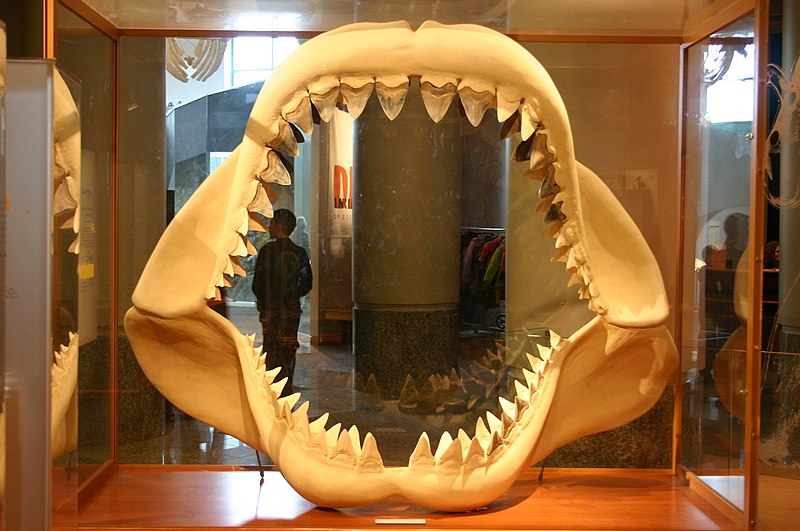
Some more scientific stuff can be found below. According to it, a 7 inch tooth would make the length of the shark 55 feet(16.7 meters) long. and those are the largest teeth found.
A freak individual could very possibly get 18 meters long, but it wouldn't be a very common occurence.