Comments (Page 387)
Latest comments by Jurassic World fans on news, forum discussions and images!
I want d-rex to win. I want sonething to win against rex for a change. But I know rex will win.

And the point of this topic is what exactly? If you quote something try and link where you got it from, that helps members get interested on what you have to say. Also, no need to title it "WTF." Posts need to have titles that reflect the body of the thread, again so people get interested and want to read. Take a look at this thread Community Rules and Conduct Expectations (Please Read)
If you have any questions please PM Admin Svanya, she will help you.
Future reference, please have longer topics overall.
Personally, I'm Team T.rex and always will be ;)
Nice...

Couldn't flip it, but at least it's here.

That is... beautiful. I like its deep sleep animation best.

i agree with you it should be interesting to see
why not getting collin trevvorowws opinion on this

Welcome to the JW forums.
Im much more on the Godzilla forums, although I am here more often now because im especially excited for Jurassic World given JP is my second favourite franchine after Godzilla.
I never noticed that, well if you see on the map there is a large restricted part of the island, and due to the Raptors intelligence, I guess they are taking extra precautions with designing security, and they must have used the Raptors for training with Owen.
i said temperature & temperament(mood):
"Instead, their color changes intiated by temperature or temperament of the animal for example:
https://www.youtube.com/watch?v=JaKk5dDWo-U"
If you feel so inclined to check it out for yourself:
http://www.jurassicworldnews.com/community/forums/topic/39005
this paper goes into great detail on why veiled chameleon males turn brighter shades of color( aggressive tempermental tendencies towards other males) if you agree on my first point, why not the last? and my second source explicitly states they don't change color to blend into their environment, because they don't. put a panther chameleon by a white background with, say a cat near by, it's not going to turn 100% white. in fact, it's going to stick out like a sore thumb. Do you have a paper stating otherwise?
PS- its perfectly fine to disagree with me; don't take my posting style as me being an ass, just how i debate ;)
your post is good and all but you contradicted yourself a few times. You say chameleons change color because of tempature but your abstract says they change color because of social interactions. And the truth is that they change color due to both wanting to blend in with their envoiornent and to attract or intimidate other chameleons. Anoles are not chameleons do don't compare them. I know they change color based on their mood. I never doubted you or meant anything wrong to you. I was just simply disagreeing With you.
T rex should be held untill mid moviE !
I want a build up like the first film and thrn it all happens!
if rex is shown too early there is no appeal left. Nothing worse than trailers showing all the bet bits
Paden is right.
Gd research tho, toooooo much to read though, i got bored sorry :( lol
thought id gone in wikipedia!
D rex will just change coulour to be hard to spot! Just will make the night scenes during the hunt tht extra bit scary i assume! Looking forward to seeing it properly!

when the mosasaur eats the d rex it will be awesome.
FEEDING SHOW INDEED!
I have to say... I like that she looks like she just stepped out of a medical marijuana dispensary... nice touch!
I think they want to make as much money as possible so yes. you will have your game

An excellent job. She looks vicious, just as we want her to be!
I'm guessing that the thumbs are out of sight in this view, right?

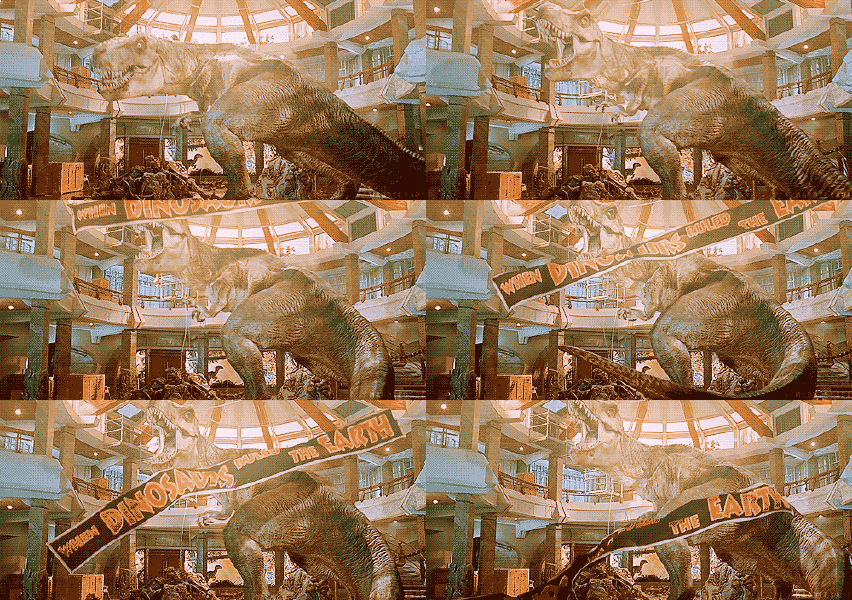
Very cool! I will be posting my depiction and more when a project me and Gojira2k are working on is finished. :)

ABORT ABORT ABORT
That is not Concept art. Not in the slightest. This was proven to be a Fans Idea of what They thought it might look like a couple months ago.
All current Trailer footage shows that D-Rex is actually a Pale colour, Suggesting the Cuttlefish having Filled in the Hide, Giving it the Camoflauge abilities.
Giving it the Ability to Hyptonize Prey and Change it's skin would be a little Overkill. Creating a Creature no one can kill is, Well... For lack of better words, Impossible? But Human nature.
I'd like to say that all of the More recent Leaked concept art for it, The Cuttle fish contributes to its creepiness.

LORD OF THE SPINOSAURS - How very interesting! That conceptual piece is compelling in the extreme! :)
CARNOSAUR - Wow! I actually produced a piece concerning the chromatic ranges evidenced by chameleons during my graduate schooling - and I wish I had been privy to some of the information you've presented here! This is very neat and fun reading! Thank you for sharing this! :)
we really don't need multiple topics of the same subject...
any time LOTS! @TK, I mistook it? not at all.
Chameleons communicate with complex colour changes during contests: different body regions convey different information
ABSTRACT
Many animals display static coloration (e.g. of feathers or fur) that can serve as a reliable sexual or social signal, but the communication function of rapidly changing colours (as in chameleons and cephalopods) is poorly understood. We used recently developed photographic and mathematical modelling tools to examine how rapid colour changes of veiled chameleonsChamaeleo calyptratus predict aggressive behaviour during male–male competitions. Males that achieved brighter stripe coloration were more likely to approach their opponent, and those that attained brighter head coloration were more likely to win fights; speed of head colour change was also an important predictor of contest outcome. This correlative study represents the first quantification of rapid colour change using organism-specific visual models and provides evidence that the rate of colour change, in addition to maximum display coloration, can be an important component of communication. Interestingly, the body and head locations of the relevant colour signals map onto the behavioural displays given during specific contest stages, with lateral displays from a distance followed by directed, head-on approaches prior to combat, suggesting that different colour change signals may evolve to communicate different information (motivation and fighting ability, respectively).
1. INTRODUCTION
The colour of most animals is relatively fixed (e.g. in dead tissues like exoskeleton, scales, feathers and hair), but some animals are capable of undergoing rapid, physiological colour change which allows them to display different colours and patterns in response to changing environmental contexts (e.g. predators [1], temperature [2] and humidity [3]). A few taxa (predominantly cephalopods, fish and reptiles) also are capable of physiological colour change during intraspecific interactions. Chameleons (Squamata: Chameleonidae) represent an intriguing subject for research on dynamic coloration because, unlike organisms that undergo localized colour change [4] or rely on achromatic pattern alterations [5], they exhibit complex colour changes during social interactions [6]. In fact, selection for conspicuous signals is likely to have driven the evolution of display colours for some chameleons [7]. The complexity of chameleon colour change may permit dynamic signalling opportunities for chameleons, whereby they use diverse chromatic elements on the body to reveal distinct information, either over the course of social interactions or across different behavioural contexts.
To date, most research on physiological colour-change signals has focused on simplified on/off signals [4,5] or mechanistic (e.g. cellular and endocrine) controls [8], with less emphasis on adaptive significance and information content [9]. The relative paucity of investigations undertaken on the signalling role of physiological colour change may be due, in part, to the technological and methodological challenges associated with quantifying such a dynamic trait. However, recent advances in the photographic quantification of colour [10,11] and the visual systems of animals [12] now enable rigorous, non-invasive analyses of colour change, as it occurs and is perceived by conspecifics during social interactions. Here, we present the first study using these photographic [10,11] and analytical methods [11,13], as well as organism-specific visual models [12,14], to examine how dynamic colour changes of veiled chameleonsChamaeleo calyptratus predict behaviours in male–male contests. Though animals engaged in contests have conflicting aims, there is a shared benefit in avoiding unnecessary escalation of such contests. Dynamic signals, for example those provided by multi-component colour changes, may allow contestants to flexibly communicate motivation or ability during contests and could therefore contribute to evolutionarily stable strategies [15].
Male veiled chameleons are well known for intense intrasexual aggression (see electronic supplementary material, S1), yet agonistic encounters are frequently settled prior to physical contact, putatively through visual signals including rapid, body-wide colour change [6]. Here, we attempt to uncover the components of colour change linked to escalation behaviour (likelihood of approaching an opponent) and contest outcome (likelihood of winning a fight) by evaluating 28 different colour patches (figure 1) from displaying veiled chameleons during staged agonistic encounters. Specifically, we focused on the rate and degree of colour change (calculated using known sensitivities of chameleon photoreceptors [14]), as well as the maximum brightness of each colour patch, during aggressive interactions.

Figure 1.
Colour patches measured during male–male competition between veiled chameleons. (a,b) Interindividual variation in location of colour patches can be seen by comparing the location of colour patches in (a) to those in (b). Because exact locations of colour patches varied among individuals, we focused on similarly located colour patches of equivalent pigmentary and structural makeup. Descriptions of colour patches and relevant principal component loadings are located in the electronic supplementary material, table S4.
2. MATERIAL AND METHODS
In spring 2011, we staged a series of aggressive, dyadic encounters between 10 adult male veiled chameleons in a round-robin tournament format that matched each chameleon against every other chameleon in our study population (see electronic supplementary material, S2). Trials were recorded with two high-definition video cameras that also enabled us to take still photographs of each chameleon. Though chameleons can exhibit a complex suite of behaviours during agonistic encounters (e.g. hissing, tail-curling and rocking),[Temperament in intraspecific associations] the most salient signals relate to the probability of escalating and winning aggressive encounters [15]. Thus, we monitored both escalation likelihood (whether or not a chameleon moved in a directed fashion toward its opponent) and win/loss outcome (losing chameleons retreated from their opponent at some point during the trial). We then used matrices of approach behaviour and contest outcomes to determine ‘ability’ scores using Bradley–Terry models (see electronic supplementary material, S6). Both chameleons displayed aggressive behaviour and rapid colour change in 17 of our 45 contests.
We collected data on brightness and colour change from 28 different colour patches on each chameleon (encompassing a variety of chameleon body regions and colour types; figure 1) that were photographed every 4 s during display, approach and combat phases of the trials. We first equalized and linearized photographs [11], then used specialized mapping functions to convert RGB (red, green and blue) values from these photographs to relative stimulation values of the different chameleon photoreceptor types (see electronic supplementary material, S3). Photographically derived estimates of chameleon photoreceptor stimulation values obtained from an independent dataset did not differ from spectrophotometrically determined values (see electronic supplementary material, table S2 and figure S2).
Because chameleon display coloration and change has never been quantitatively analysed with respect to intraspecific variation in behaviour, we measured the amount and speed of colour change, as well as maximum display brightness (previously suggested to be an informative component of squamate colour signals [16]). We measured colour changes as: (i) the perceptual distance travelled (sum of distances between colour measurements taken at different times) and (ii) rate of colour change (perceptual distance/time), both measured using units of just noticeable differences, which capture perceivable changes in colour taking into account species-specific photoreceptor sensitivities [13,17] (see electronic supplementary material, S4). Brightness was quantified by calculating how each colour patch would stimulate chameleon double cones, though only maximum brightness was evaluated in model-averaging and regression analyses.
We used principal components analyses to reduce the number of variables within three body regions (head, stripes and main body; electronic supplementary material, S5 and table S4) and an information theoretic model-averaging approach to evaluate the relative importance (RI; the sum of Akaike weights for all models in which that variable appeared) of colour intensity and change (averaged for each chameleon across trials) in predicting the likelihood of approaching an opponent or winning aggressive interactions (see electronic supplementary material, S6). Lastly, we included predictor variables from the top models in regression analyses to determine the degree to which colour traits explained variation in approach and winning abilities.
3. RESULTS
Approach and fighting abilities were highly correlated (r = 0.84, p = 0.003), though the colour metrics that best predicted these outcomes were different. Specifically, maximum head (RI = 0.32) and stripe brightness (RI = 0.60) achieved were the best predictors of approach ability during agonistic encounters (figure 2a; electronic supplementary material, table S5); in regression analysis, maximum stripe brightness explained 71% of the variation in approach likelihood (figure 2c). Chameleons who displayed brighter heads (RI = 0.80) that changed colour faster (RI = 0.31) were more likely to win physical encounters (figure 2b; electronic supplementary material, table S6). A regression containing only maximum head brightness explained 83% of the variation in fighting ability (figure 2d).

Figure 2.
Explanatory variables associated with escalating and winning contests. Multi-model averaging indicates that average maximum stripe brightness (principal component, PC) best explains the likelihood of (a,c) a chameleon approaching his opponent and (b,d) that average maximum head brightness (PC) best explains the likelihood of a chameleon winning a fight. (a,b) Bar length is proportional to RI values of variables predicting (a) likelihood of approaching an opponent or (b) likelihood of winning an aggressive interaction, with green bars indicating RI values greater than 0.60 and orange bars indicating RI values greater than 0.30. Average parameter estimates of regression coefficients (?) were obtained using multi-model-averaging approaches and dots indicate parameter estimates with absolute values less than 0.005. (c) Regression of chameleon stripe brightness and approach ability calculated across trials. Average stripe brightness values represent PC scores, all of which had negative loadings of maximum brightness values (chameleons with brighter bodies had negative PC scores). (d) Regression of head brightness on fighting ability. Colour-metric predictor variables in (a–d) represent principal component scores from multiple colour patches within a region (see electronic supplementary material, table S4). Abilities plotted in (c,d) represent Bradley–Terry ‘ability’ scores.
4. DISCUSSION
We found that different aspects of chameleon competition (approach likelihood and contest outcome) were best predicted by separate components of display coloration—maximum stripe brightness and maximum head brightness, respectively. We also found that rate of colour change was an informative component of aggressive displays; chameleons whose head coloration changed faster were more likely to win agonistic encounters. Taken together, these correlational findings represent the first demonstration that multiple components of rapid colour change can be used to signal different aspects of competitive behaviour (e.g. motivation and fighting ability).
Selection may favour separate signal components for motivation and fighting ability [15] because these two aspects of competition can differentially affect contest outcomes; for example, regardless of true ability, animals who fight harder to defend mates or territories can often overcome less-motivated competitors. Separate signals may also be favoured when rival assessment is prolonged and animals progress through a series of escalation and threat behaviours, as occurs for slow-moving chameleons that have the opportunity to sequentially evaluate competitor intent and quality. Interestingly, the physical locations of the key colour-signalling elements of veiled chameleons align closely with the behaviours they exhibit during agonistic encounters. Aggressive chameleons display laterally to one another from a distance before approaching, providing their opponents the opportunity to assess body stripe coloration (which best predicted escalation likelihood in our study). Next, as they approach and prepare to engage in head-to-head combat (see electronic supplementary material, S1 and video S1), they have close visual access to head coloration (which best predicted win/loss outcome). Separate plumage patches in lark buntings Calamospiza melanocorys also convey different information about approach intensity and physical aggression [18], but our study is the first to document the use of multiple, behaviourally accentuated colour-change signals to communicate different information.
Costly intraspecific conflict over resources is common throughout the animal kingdom, yet rapid colour change as an agonistic signal is incredibly rare and warrants special examination. One possible explanation for the link between rate of colour change and fighting ability is that expression of bright, rapidly changing colours is causally related to the physiological processes (e.g. hormone status and energetic reserves) associated with fighting ability [4]. An alternative, though not exclusive, explanation suggests that it is more costly for strong individuals facing strong opponents to signal weakness before signalling strength (analogous to brightening slowly) than it is to initially signal strength [15], providing the evolutionary pressure to rapidly signal fighting ability when strong. Regardless of the explanation, documenting the behavioural contexts in which colour change signals occur is an important first step in understanding the function and evolution of this relatively rare signal type and should markedly inform our views on competitive signalling theory. Moreover, future detailed studies of the physiological mechanisms underlying display coloration will be key for revealing the information communicated by rapidly changing colours.
http://rsbl.royalsocietypublishing.org/content/9/6/20130892
--------------------------------------------------------------------------------------
This paper is basically showing how/ why male veiled chameleons will change their coloration when in contact with other males of their species. Aggressive tendencies were signified by brighter colorations, hissing, mock charging, etc.
Want more?
Fine.
Myth: Chameleons change color to match their environment.
Chameleons don’t change color to match their environment. Rather, they change color as a response to mood, temperature, health, communication, and light.
ow, not all kinds of chameleons have the ability to change color and some only have limited ability for color changing; for instance, many types of chameleons can only turn, green, brown, or gray. Others have the ability to change to a variety of different colors including: pink, blue, red, orange, green, black, brown, blue, yellow, turquoise, and purple. Of the ones that can change color, they’ll often change to darker shades, when they are cold, and will lie out in the sun during this time. Likewise, if they are hot, they can change to lighter colors which will reflect the sun better, helping to cool themselves off.
Most color changes though are simply due to mood changes or for communication purposes. For instance, the Panther Chameleon will change to red and yellow when they are angry or are getting ready to attack. This serves as a warning to other chameleons and humans to back off. Some types of male chameleons will also change to mixed bright colors when they are trying to attract a nearby female chameleon.
--------------------------------------------------------------------------------------------------
Anoles don't do this either. They change to their dark tinge of brownwhen they're cold, this is an effective mechanism in absorbing heat. (I know from personal experience, i owned one for years) It's also an indication of stress, as are dark post orbital dark spots.
I do know what i'm talking about, thank you.
True. I know, weird right?

Yes, you have a point. Though I personally think they put the Cuttlefish DNA in there because it would give D-Rex more abilities, not just color changing. Examples are shape-shifting skin, three hearts, and the ability to hypnotize or stun its prey. Though the Chameleon is unique, though the thing I find the most bizarre about it is the fact that its tongue makes up about half its weight.
I am a reptile lover and (dare I say) expert. And chameleons do not change color based in temorbit by mood and to blend in with surroundings. Carno probably mistaked it for anoles who change color through temp.
Thank you very much for your inputs guys! .
Indeed there are plenty of dinos to chose from, it could be the dilophosaurus, or the metriacantho, the sucho or the bary but what intrigued me the most is this. .
At first i kinda just let it pass as a normal dino sound (it could be anything), but when i read the comments from youtube or other websites im surprised that to other people they think they heard a Velociraptor, i for one think it was a t-rex and so is many other people so i decided to investigate.
The animal did sounded like a t-rex at first, the casual gurggling sound it makes when its inspecting something, and then a few seconds later it suddenly sounded like a raptor (notice the hooting sound it made) :)
But then again i could be wrong, i just wanted to share it with you guys, what do you guys think?
I signed up for raptor pass. Nothing has happened yet.
I really hope it doesn't have extreme jumping capabilities. That would be completely and totally ridiculous. Judging by the legs we saw in the trailer, this animal is similarily sized to the T. rex. An animal that size should not be able to jump, as it would cause more bodily harm that it's worth.
And no, the "theme park monsters" arguement doesn't work here. This is physics, not biology.
Has someone down the RaptorPass thing? I want to know if it's worth it.
D-REXMANIACFAN3354 - I would absolutley adore a new game within the Jurassic Park universe! FACT DUDE presented an excellent notion with the "Free Roaming" concept in which you'd get to choose your own animal to explore the setting! That would be bloody magnificent! Of course, I'd also enjoy a game in which I play a little human trying to survive upon the island in a "Survival-Horror" setting that forces me to out-think and evade the predators interested in having me as a replacement for their mourning tea and biscuits! Maybe something like Alien: Isolation! :)
TYRANT KING - This was a very neat and insightful topic! Indeed, our perceptions of these animals have changed significantly over the years - broadneing and constricting as we learn more about them through what we can discover in the ancient Earth. Thank you for presenting this thought provoking bit of information! :)

Nice point! :)
I think he's running with the raptors into battle with the D. Rex. (The dinosaurs look pretty realistic to me. It's JURASSIC PARK! There's supposed to giant raptors and not feathered dinosaurs.)
I believe they are (who's they BTW? :o) All I know of is Prehistoric Kingdom, which is sort of like a JPOG/Zoo Tycoon 2 mix, and I can't wait for it.